
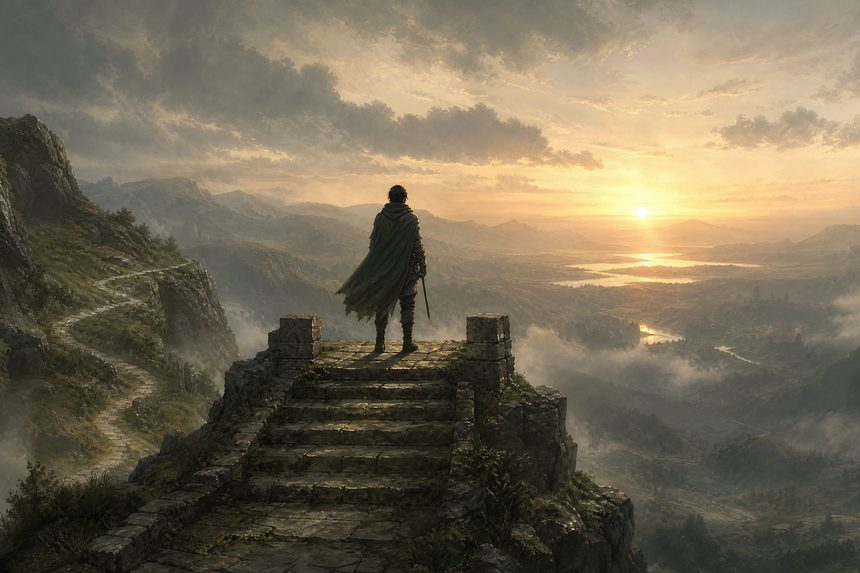
Somewhere in the production of every large game there is a document describing the ending, and somewhere rather later there is the ending that actually shipped. The distance between the two is not usually a story about compromise or cowardice. It is a story about testing, and about how few people ever reach the last hour under the conditions that matter.
Consider what an opening hour receives. It is played by the whole team, by every external tester, by press, by anyone who installs a demo, and by every player who buys the game. Feedback arrives in volume, early, and repeatedly, and there is time to act on it. If a tutorial confuses people, that fact is unmissable and it gets fixed.
Now consider the final hour. Reaching it legitimately takes twenty, forty, sometimes eighty hours. Nobody on the team does that more than a handful of times, because there is work to do and a debug menu three keystrokes away. External testers are usually warped in. The ending is therefore evaluated almost entirely by people who arrived without the accumulated weight the ending is supposed to release.
The debug warp problem
I want to be precise about the mechanism, because it is not that developers are careless. It is that the tool which makes late-game development possible also removes the exact quality being tested.
An ending works by discharging accumulation. Forty hours of travel make the return to the first town mean something. Twelve hours of a companion's presence make their absence register. Warping directly to the final area preserves every asset, every line and every mechanic, and destroys the only ingredient that cannot be authored: the time behind you.
| Condition | Opening hour | Final hour |
|---|---|---|
| Played by whole team | Continuously | Rarely, usually warped |
| External test coverage | Very high | Low, often abbreviated |
| Built in the schedule | Early, revised often | Late, revised once |
| Tester brings accumulation | Not required | Essential, usually absent |
| Feedback loop length | Minutes | Tens of hours |
Read that table as a description of an information problem rather than a moral one. The team knows less about its ending than about any other part of its game, and the thing it knows least about is precisely the thing that determines whether the ending lands.
You cannot test the weight of forty hours by skipping to hour forty-one.
What this looks like in the hand
Across the nine games in my notes for this essay, the symptoms recur with a consistency that suggests a shared cause rather than nine independent failures of nerve.
The most common is a final act that introduces a new mechanic. This is almost always a sign that the ending was designed in isolation, because a mechanic introduced in hour thirty-eight of forty has no room to become anything. It is presented, used twice, and abandoned, and in four of my nine games it actively displaced the mechanic the previous thirty hours had taught me to love.
The second is difficulty that spikes without warning. A player who has warped in tunes the final encounter for the equipment and skill they arrived with, which is whatever the warp gave them. A player who walked there arrives with something quite different, and the encounter is calibrated for a person who does not exist.
The third, and the one I find saddest, is the ending that references the journey in dialogue while doing nothing with it structurally. A character says that it has been a long road. The game says nothing at all: no returned location, no changed music, no callback that requires you to have been there. The line is doing work the design declined to do.
The two games that solved it
Two of the nine handled this well, and in both cases the solution was structural rather than narrative.
The first spends its penultimate hour returning you to three locations from its opening, changed in small, specific ways. No dialogue explains this. The changes are only legible to someone who saw the originals, which means the sequence cannot be evaluated by a tester who warped in, and someone on that team clearly understood as much and protected the sequence anyway.
The second does something simpler and rarer. Its final hour introduces nothing. No new mechanic, no new enemy type, no new system. It asks you to use what you have learned in a configuration you have not seen, which requires no fresh testing to validate and rewards the accumulation directly. It is the most confident final hour in my notes and it is also, by any measure of assets produced, the cheapest.
| Approach | Games in notes | Effect on the ending |
|---|---|---|
| New mechanic in final act | 4 | Displaces what came before |
| Unwarned difficulty spike | 3 | Calibrated for a warped tester |
| Journey referenced in dialogue only | 5 | Line does the design's work |
| Returns to early locations, changed | 1 | Rewards accumulation directly |
| Introduces nothing new | 1 | Most confident finish in my notes |
Why the cheap solution is rare
If introducing nothing is both effective and inexpensive, its rarity needs explaining. I think the answer is that a final hour has to look like an ending to the people approving it, and looking like an ending has come to mean escalation: bigger arena, louder music, a mechanic nobody has seen.
A final hour that introduces nothing looks, in a review meeting, like an unfinished final hour. It is difficult to defend a sequence whose quality depends entirely on a property no one in the room possesses, because everyone in that room has warped in.
What I would ask for
One thing, and it is a scheduling decision rather than a design one. Somebody on the team should play the whole game, legitimately, from the beginning, in the last month, and their notes on the final hour should carry more weight than anyone else's. It is expensive in a way that shows up on no asset list and it is the only test that measures what the ending is actually for.
The rest follows. A person who has walked forty hours will notice that the new mechanic is unwelcome, that the difficulty assumes equipment they do not have, and that the line about the long road is unsupported. None of this requires insight. It requires only that somebody arrive carrying what a player carries.
The argument in one sentence
Endings are the least-tested hour of any large game because reaching them honestly is expensive, and the tool that makes late-game work possible removes the accumulated time on which every ending depends.