
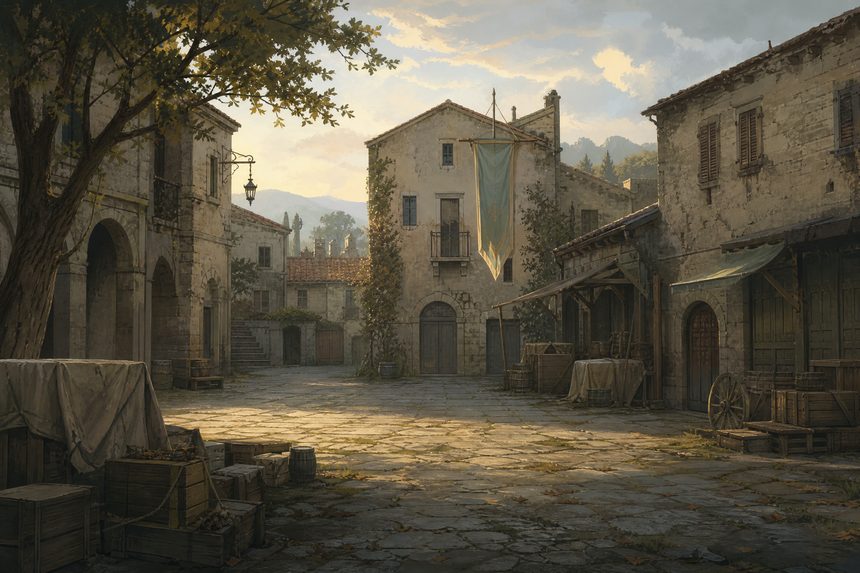
There is a peculiar loneliness available in this medium and almost nowhere else. You finish a long game, the credits run, and then you are put back into the world a few hours before the end, with the crisis resolved and every mechanic still functioning. The shops are open. The quest markers are gone. Nothing needs you.
I do not think this state is a mistake in itself. It exists because players asked for it, and the request was reasonable: having built a character across fifty hours, being locked out of the world at the moment of completion feels punitive. The problem is that granting the request created a room nobody designed, and most games furnish it with whatever was already lying around.
Three kinds of afterwards
Across the seven games in my notes, the post-game state falls into three fairly clean categories, and it is worth naming them because they are frequently discussed as though they were one thing.
The first is the continuation: the world persists, side content remains, and the main narrative is simply absent. This is the commonest arrangement and the least satisfying, because the game's own systems now argue against its ending. If the threat is defeated, why is the guard captain still worried about wolves.
The second is the settled world: the game changes its spaces to reflect the resolution. Dialogue is rewritten, some locations are altered, the music shifts. This is expensive and rare, and two of my seven games do a partial version of it, which is to say they change the four or five places a player is most likely to revisit and leave the rest alone.
The third is the closed door: the game ends and does not return you. Your save is your save, before the point of no return, and the ending is a terminus. Two games in my notes do this, and both are stronger for it, though I understand entirely why the arrangement is unpopular.
| Arrangement | Games | What it costs | What it gives |
|---|---|---|---|
| Continuation | 3 | Almost nothing | Access, at the price of coherence |
| Settled world, partial | 2 | Significant rewriting | A world that acknowledges you |
| Closed door | 2 | Player goodwill | An ending that stays ended |
A world that has been saved should not still be asking for help with the wolves.
The coherence cost, precisely
I want to be careful here, because it would be easy to overstate this. Most players do not spend long in the post-game state, and a certain amount of inconsistency is invisible at that duration. The cost is specific rather than general.
It falls on the ending itself, retroactively. If a game shows me a final scene about a changed world and then returns me to an unchanged one, the final scene becomes something the game said rather than something the game did. This is the same problem the ending of a novel would have if the last chapter were followed by a reprint of chapter thirty.
In two of my three continuation games, the retroactive damage was noticeable within twenty minutes: a companion who had died in the ending appeared at their usual post, and a settlement described as destroyed was intact and trading. Neither is a bug. Both are the direct consequence of leaving a door open without deciding what should be on the other side of it.
What the settled world achieves
The two games that reshape their spaces demonstrate how modest the intervention needs to be. Neither rewrites everything. Both concentrate on the four or five locations a player is overwhelmingly likely to revisit, and both change them in ways that are cheap to produce and impossible to miss.
In one, the market square that opened the game is being repaired: scaffolding, new stalls, three lines of fresh dialogue from a trader who remembers the crisis. In the other, a single piece of music is replaced. That is all. The theme that played over the region for sixty hours is gone and a quieter arrangement of it is in its place.
The music change affected me more than any amount of new dialogue could have. It required, presumably, one new asset and one flag, and it made the world feel like the aftermath of something rather than the middle of it.
| Intervention | Approximate cost | Effect in my notes |
|---|---|---|
| Replace regional theme with quieter arrangement | One asset, one flag | Strongest effect recorded |
| Alter four high-traffic locations | Moderate art and script | World acknowledges the ending |
| Rewrite dialogue for named characters | Substantial script | Effective, rarely completed |
| Full world state change | Very high | Not seen in these seven |
In defence of the closed door
The two games that refuse to let you back in are, I think, the most honest of the seven, and they are honest in a way that costs them affection.
An ending is a claim that this is where the thing stops. A game that then permits fifty more hours of wandering has weakened its own claim in exchange for convenience, and there is no version of that trade in which the claim survives intact. Closing the door is not austerity. It is a game declining to undermine itself.
What the closed-door games share is that both make the point of no return unmistakable and both give you a long, quiet stretch before it. You are told, in effect, that this is the last chance to go and look at things, and then you are allowed to go and look at things. The post-game state is moved in front of the ending rather than behind it, which is the same content in a better order.
The suggestion
If a game intends to return the player to the world, the state should be designed rather than inherited: a small number of changes in a small number of places, and the music. If it does not intend to, the approach to the ending should be long and open enough that nothing is lost.
What does not work, and what three of my seven games do, is to leave the door open and put nothing behind it. That arrangement takes the ending you have just been shown and quietly contradicts it, using systems that are working exactly as built.
The argument in one sentence
A post-game world is a designed space or a contradiction, and the cheapest version of designing it is one changed piece of music and four changed rooms.