
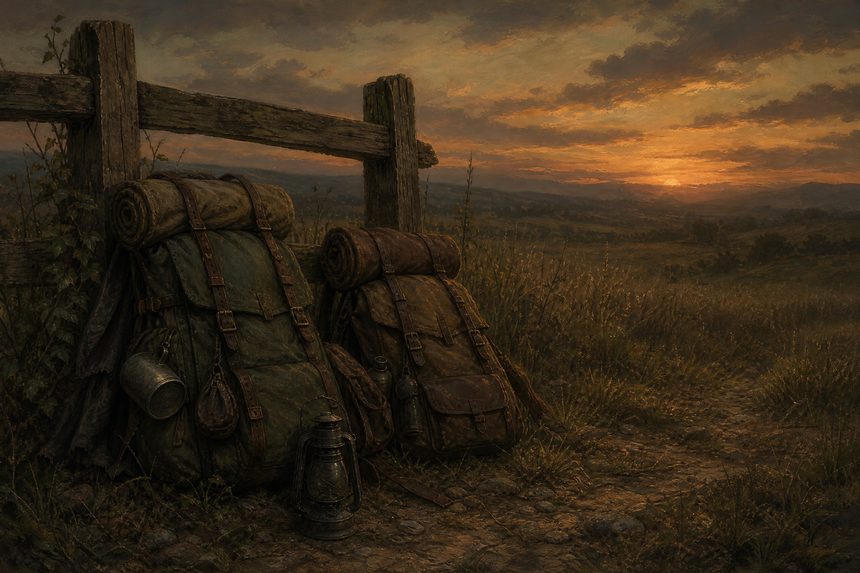
The companion I remember most clearly from any game I have finished said almost nothing to me. She had a handful of barks, one substantial conversation at roughly the halfway point, and a habit of standing slightly too close during dialogue with other characters. I played for sixty-one hours and by the end I did not want her to leave.
This is a strange achievement to analyse, because on the page there is almost nothing to point at. The writing was competent and unremarkable. What produced the attachment was duration and adjacency: she was there, consistently, in the corner of the screen, for longer than most friendships get in a year.
The asymmetry
Here is the difficulty this creates for a farewell scene. The feeling exists in the player and has been generated by time, but the scene has to be written, and writing can only reference the time rather than reproduce it.
A film has the opposite problem and solves it with craft: two hours to build attachment, so every line must work hard. A long game has abundant attachment and a thin text, which means the farewell can be undermined by trying too hard just as easily as by trying too little.
Three of my six games try too hard. The farewell is long, explicitly emotional, and full of statements about what the journey meant, delivered by a character whose established register was laconic. The scene contradicts sixty hours of characterisation in order to explain a feeling the player already had.
| Approach to the farewell | Games | Result |
|---|---|---|
| Long, explicit, emotionally declarative | 3 | Contradicts established register |
| Brief, in character, understated | 2 | Effective; the player supplies the rest |
| No farewell scene at all | 1 | Most affecting in my notes |
The player brings the feeling. The scene only has to avoid getting in its way.
The game with no farewell
One of the six declines to write the scene entirely, and it is the one that stayed with me. Its companion is present in the final sequence, does what she has always done, and is simply not there in the epilogue. There is no speech, no embrace, no acknowledgement. The next time you enter the camp, the spot where she stood is empty and the game does not mention it.
This works because the game trusts a piece of information it can be certain about: I know how long she was there. It does not need to tell me. Any line it wrote would necessarily be smaller than sixty hours, so it writes nothing and lets the absence carry the meaning.
I want to note the risk honestly. This approach fails completely for a player who did not form the attachment, and it is indistinguishable, from the outside, from having forgotten to write the scene. It is a confident choice that looks exactly like an oversight, which is presumably why so few games make it.
The two that were brief
Between the declarative and the silent lie two games that write short, understated farewells, and both do the same clever thing: the scene is about a practical matter rather than about feeling.
In one, the conversation is about who takes which supplies. In the other, it is about a route and whether the weather will hold. The emotional content is entirely in what is not being discussed, which is exactly how the characters have spoken for the preceding fifty hours.
This is craft rather than restraint. A scene about supplies gives the player something to look at while they feel something, in the way that a conversation over a task is easier than a conversation across an empty table. Neither game is doing anything a novelist would find novel; both are doing something most games in my notes do not attempt.
On ambiguity, briefly
A related note, since I am often asked about it. Withholding resolution at the end of a story is a technique with costs and benefits, and it has acquired an undeserved reputation as the braver option.
The distinction I find useful is whether the game knows the answer. An ambiguous ending written by someone who has decided what happened and chosen not to say feels quite different in the hand from an ambiguous ending written by someone who never decided. The first is a shape; the second is a gap. Players detect the difference reliably even when they cannot articulate it, usually by noticing whether the preceding hours were consistent with any single reading.
| Ambiguity | How it reads | Tell |
|---|---|---|
| Answer decided, withheld | A shape | Earlier hours support one reading |
| Answer never decided | A gap | Earlier hours support none |
What I would ask for
Write the farewell in the register the character has used for the whole game, keep it shorter than the feeling, and give the scene a practical subject. Or write nothing, and let the empty place in the camp do the work, if the courage is available for it.
What does not work, and what half of my sample attempts, is to explain the journey to the person who took it. They were there. That is precisely the resource the scene has, and spending it on exposition leaves nothing behind.
The argument in one sentence
Attachment in long games comes from duration rather than dialogue, so a farewell should stay in character and stay short, because anything it says will be smaller than the time the player already spent.